Households headed by a lone parent with low levels of completed education are among those at greatest risk of long-term unemployment and poverty in Ireland. The economic and social disadvantage faced by these households has potential lifelong adverse consequences for children from these one-parent families.
Research conducted by the Economic & Social Research Institute (ESRI. 2023) showed that lone parent families, without an earner, had the highest risk of poverty. This confirmed a definitive link between education, employment, and poverty
The Beachaire Fund is a charitable trust operating under the umbrella of Community Foundation Ireland (CFI).
In January 2022, the Beachaire Fund engaged CES to conduct qualitative research to explore the power of community education to support lone parents to achieve improved educational, economic, and social outcomes for themselves and their children.
The primary intention of the research was to bring evidence-informed recommendations to policy makers to bolster the case for increased funding to strengthen the community education sector and to improve access for lone parents to opportunities to return to education as a pathway to fulfil their potential in education, employment, and society.
The Challenge
In 2020, the Beachaire Fund commissioned AONTAS and the ESRI to jointly conduct a scoping study into the possibility of researching the role of community education in supporting lone parents facing economic and social disadvantage in Ireland.
The Scoping Study found that there had been limited research conducted on the impact of community education programmes in Ireland. It noted the large body of international evidence telling us that person-centric educational programmes such as those at the core of community education can have a transformative impact on the lives of adult learners and that improved educational attainment for mothers can also lead to benefits for their children.
The Scoping Study recommended in-depth, qualitative, case study-based research as the optimal way to explore the experience of learners, who are lone parents, and the experience of the providers of community education, where lone parents form a significant proportion of the learner group.
What we did
CES conducted the research between June 2022 and July 2023 drawing on the experience of 8 community organisations delivering community education programmes to lone parents across Ireland. The research was participative involving over 135 lone parent learners and over 50 community education providers and managers from across the 8 community organisations.
Context setting: To place the research in context, the CES team prepared a background paper drawing on the existing research literature and the current situation relating to lone parent families and community education provision in Ireland. We hosted an online workshop and held discussions with several organisations who were interested in participating in the research. There were also individual consultations with external stakeholders, including representatives from the Education and Training Boards, Department of Rural and Community Development, and Department of Further and Higher Education, Research, Innovation and Science.
Field research: The research methodology was qualitative, appreciative, and participatory at all levels. The data was gathered through semi-structured conversations, interviews and focus groups, all designed to capture community education provision and practice as experienced by lone parents. Over 200 people contributed to the research including policy informers (8), community education management (24), community education staff/ facilitators/tutors (36), and community education participants (135).
Research report and case studies: The research findings centred around 10 messages and recommendations for policy makers. It was presented in a thematic report, a suite of 8 case studies and 11 vignettes, which is collated into one comprehensive report, and can also be read as standalone and discrete pieces of research pertinent to each of the 8 community education providers.
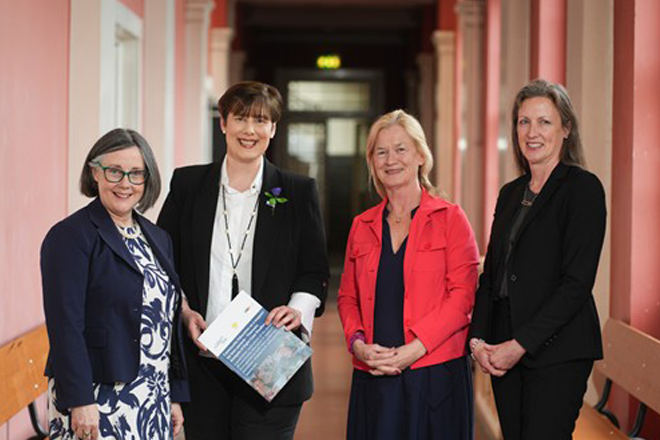
Disseminating the findings: ‘The Power of Community Education: Supporting lone parents to fulfil their potential in education, employment, and society’ research report was launched by the then Minister for Education, Norma Foley TD, in April 2024.
Throughout this complex and innovative research project, the CES team demonstrated their ability to collaborate with a diverse mix of individual learners, practitioners and the Research Advisory Committee. They have effectively drawn upon this depth and range of experience and insight to produce reports which collate and distil messages from the research and actionable recommendations for policymakers.
Sharon Burke, Funder Advisor at the Beachaire Fund
Following the report launch, CES hosted an online workshop with a wide range of people working with and/or with an interest in community education and lone parents to share the learning from the research in order to inform practice and policy.
L-R: Sharon Burke(Beachaire Fund), Norma Foley TD, Anne Eustace (CES), Dr. Inez Bailey (CES)
The Impact
Key learning from the research
Participation in community education brings feelings of connection and belonging for lone parents who may feel isolated
Participation by lone parents in community education results in personal transformation, strengthened self-confidence and personal agency which motivates progression to further and higher education.
Lone parents who complete community education programmes are highly likely to progress to further and higher education, training, paid employment, and involvement in their community.
Wraparound support, including mentoring, study skills and childcare, is a known distinctive feature of community education and is one of the main success factors for participation, completion, and progression.
Access to onsite childcare is the single biggest enabler of participation in community education for lone parents.
The quality and dedication of community education tutors/facilitators are important determinants of success.
Role models are a wonderful source of inspiration and encouragement for lone parents.
Participation in community education, by lone parents, has a positive ripple effect through the family by enhancing parental wellbeing and positive role modelling for children.
Community organisations are agile and can respond well and swiftly to local needs through strategic partnerships and practical collaboration arrangements.
Community settings and community education gather useful quantitative and qualitative data to inform education, training, and employment policy and yet use of this data is under resourced and under-utilised.
This research shows that community education transforms lives. Where the wraparound support for programmes includes 1:1 mentoring support and provision for childcare, lone parents can pursue education without worrying about their children's care, enabling them to fully engage and achieve their goals, progress in further and higher education and training, paid and better paid employment, and involvement in their community.
Sharon Burke, Funder Advisor at the Beachaire Fund
Ten recommendations for policy makers
Maximise the power of Community Education to deliver on specific policy commitments and strengthen related metrics and monitoring.
Maximise the mental health and wellbeing benefits of participation in community education for lone parents.
Promote better understanding of the mutuality between community education settings and relevant statutory providers.
Utilise the power of community education to respond to local employment needs and skills gaps.
Invest in Wraparound Supports for Lone Parents to engage in Community Education.
Ringfence Free Childcare for Lone Parents.
Invest in Continuous Professional Development (CPD) for Community Education Staff.
Recognise the value and power of good role models and the positive impact that they have on children and young people.
Recognise the power of community education as part of the suite of family support and interventions to address child poverty.
Incentivise collaboration and partnership.
The participants had a great day out and came away feeling that their experiences were heard, and their input could make a real difference in the future.
Sharon Burke, Funder Advisor at the Beachaire Fund
The research report and case studies can be foundhere.